183 Clover is the buy. The proof is right next door: a working 8-bed, 8-bath compound — main house, trailers, RVs, tiny home, duplex cottage, efficiency and five room rentals — clearing twelve thousand dollars a month at 184 Clover / 180 Ladybug, owned by Paul, separate from this deal. Copy the playbook, add your metal building, and unlock the Johnson Strip behind 183 — and with it roughly half a dozen landlocked five-acre tracts, including the old watermelon farm that once fed Bastrop County off an artesian well still on the property, all knitting directly into Paul's 180 Ladybug Lane / texascoworking.com / texasliving.com complex. 2–3× the comp on a single parcel. The Del Valle bet is years out. This one stands on rails that already work.
Anil, the Del Valle play near the F1 circuit is a someday-maybe. It needs entitlements, neighbors who don't fight you, utility runs, a parking variance, and a long marketing climb before the first dollar comes in. Years of carry cost. Zero revenue in the meantime.
183 Clover is the opposite kind of bet. Right next door — 184 Clover / 180 Ladybug, owned by Paul, not part of this sale — a near-identical compound is already grossing $12,000+/month from a stack of nightly, weekly and monthly rentals. You can see it, count it, and underwrite it line-by-line in the worksheet below. That's your comp. Same road, same buyer profile, same nightly rates, proven to work.
183 Clover is the parcel for sale. Drop your metal building on it, add an aerobic septic, and copy the next-door playbook unit-by-unit. The worksheet's stabilized column is what 183 can reach once it's running the same model — two to three times a starting baseline — and once the Johnson Strip behind it is brought in.
Sell Del Valle. Owner-finance 183 through Matt Walker. Pattern it after the proven enterprise at the property line. Be cash-flow positive long before the Del Valle parcel would have broken ground.
Each one stands on its own. Stacked, they make the trade obvious.
The compound at 184 Clover / 180 Ladybug — Paul's place next door — is already grossing $12K+/month. You don't have to invent anything. You copy a unit stack you can see, count, and walk through. Del Valle has no analogue.
An $144K/year operating enterprise is the adjacent parcel — same road, same buyer profile, same nightly rates. You're not betting on a thesis. You're stepping into a proven one and replicating it on 183.
Worksheet below shows the next-door comp at $12K. Patterned on 183 with your metal building plus an aerobic septic, plus activation of the Johnson Strip behind it, stabilized revenue targets $24K–$36K/month — meaningfully above the comp because 183 has the upside the existing enterprise doesn't.
Matt Walker can close this deal and structure the note directly with the current owner. No bank, no rate sheet, no DSCR underwriter — just terms you and the seller agree to.
Cedar Creek + Bastrop County is friendlier to outbuildings and aerobic septic than Travis County's F1-corridor parcels. Less code resistance, faster Cert of Occupancy, cheaper utility tie-in.
Sell the F1-adjacent lot. Roll proceeds into 183. Net effect: swap a carrying-cost-only parcel for a cash-flow compound + a still-buildable site for your metal-building enterprise.
Two parcels. Two timelines. Two cash-flow profiles.
Cindy Donley owns 183 Clover. She also owes Paul and Dorothy the balance of a separate amortizing Note from a 2018 land sale on the other side of their property. Her health and finances have moved in the wrong direction. On March 12, 2026, she emailed Paul and Dot directly with a proposal that re-shapes every conversation about 183 — including what Anil is actually being asked to do.
"Dear Paul and Dorothy,
I did have heart failure last year and have had a pacemaker put in. Needless to say, I'm not at the capacity that I've been at in the past. Hence it's taking me a lot longer to get tasks done, and some not at all.
My finances are a bit more difficult to maneuver. As a result, I have put the 1.84 acres up for sale on the other side of y'all. It is priced at 175k. Would you be interested in a trade? The land in trade for the balance of our agreement, which is now at 134,874.80.
I understand this may not be of interest to you, if not, I will continue to make payments with some months being later than normal.
Since I do not want to make partial payments, I'm waiting until I have entire payment to send it to you. I foresee that being this weekend, this month.
Let me know your thoughts and we will proceed from there.
Thank you for your consideration,
Cindy"
The pitch as originally framed. Anil offers below ask, Matt Walker structures owner-finance with Cindy as seller, Anil takes title at close. Paul keeps collecting on the existing Note from Cindy as before.
Paul and Dorothy accept Cindy's March 12 proposal. The Note balance ($134,874.80) is cancelled. Title to 183 transfers to Walhus/Epp. Cindy is out from under the receivable; Paul/Dorothy own the parcel adjacent to their compound at an effective basis of $134,874.80 (below the $175K asking).
Then Paul + Dorothy form an operating JV with Anil to develop 183. Anil contributes: metal building, operating capital, Tiny Hacker House brand, sweat. Walhus/Epp contributes: the parcel itself, the playbook, the Park Strip equity. Cash-flow split per JV agreement drafted by Bradley Lingold.
Paul + Dorothy accept Cindy's trade (Path 2 first step). Walhus/Epp now own 183 outright with a $134,874.80 basis. Then immediately resell 183 to Anil at $175K with Walhus/Epp carrying the paper — owner-financing terms friendlier than Cindy could ever offer, structured with Anil's survival window in mind.
Walhus/Epp net a new $40K+ on the resell to Anil (covering taxes, ops, legal). Anil deals with a friendly, motivated, operations-aligned seller (Paul) instead of one tangled in 8 years of separate legal history. Cindy gets out clean. Anil gets a clean seller. Walhus/Epp turn a stressed receivable into an appreciating real-estate asset and a new performing note.
Before Cindy's email, the assumption was a normal arm's-length sale. After the email, the picture is different: the seller is stressed, motivated, and proposing a structure that doesn't require Anil's capital to clear the parcel. The trade-equivalent value she's accepting ($134,874.80) is materially below her $175K ask — already a private discount baked in.
For Anil, this means the offer band on Path 1 just got more workable (Cindy needs cash) and Path 2/3 became viable (Paul can step in as principal seller). For Paul, the receivable Cindy can no longer reliably service becomes the foundation of a much stronger position: equity in the parcel directly, then a fresh performing note from an operating partner.
Paul's tactical posture as of mid-May 2026: requested full payment from Cindy this weekend to test her ability; she sent $2,500 partial. The trade option remains open. Matt Walker can structure whichever path the principals choose. Bradley Lingold reviews the trade-and-resell tax treatment before any signature.
This worksheet is the property next to 183 — Paul's existing operation at 184 Clover Rd / 180 Ladybug Ln — not part of the 183 sale. It's shown here because it's the closest comp on the planet to what 183 can become: same road, same buyer pool, same unit mix, proven economics. Sort any column. Search by type. Footer totals update with whatever you filter. The "stabilized" column is what 183 would target once it copies this model.
| Unit / Asset | Type | Size / Bed·Bath | Status | Current Rent | Stabilized | Lift | Underwriting Note |
|---|---|---|---|---|---|---|---|
| TOTAL — visible rows | $0 | $0 | $0 | 0 units | |||
183 doesn't sit on raw road frontage somewhere. It sits in the middle of a documented twelve-parcel corridor with a working enterprise on one side, a Sangha-anchored Cedar Creek neighborhood on the other, and a Park Strip behind. These are the actual neighbors at the actual addresses — pulled from BCAD ownership records, not from a real-estate listing.
The Park Strip is the access easement that connects 183 (and the rest of the Clover-side parcels) to the back acreage. Paul has carried the entire annual tax bill on R-22475 for years — while the named co-owners, including the now-incarcerated Harmons, have contributed nothing. In Texas, sustained sole-tax payment on co-tenancy property is a documented equity argument when title is later partitioned or litigated. Anil acquires 183 with Paul's tax-built equity already standing behind the access corridor. That isn't a paper benefit. That's a court-defensible one.
The Clover Rd corridor runs on a private road, a shared well system, and a Sangha that collects annual water/road/parkland dues. The relationships are mostly cooperative — but not uniformly so. Anil should know the temperament he's stepping into, especially around guest-vehicle access (the daily reality of STR operations).
The Clover-side property owners share three operating funds, billed annually by Dawn Maus (dmaus65@gmail.com) on behalf of the Sangha. The 2023 dues call went to 13 households including Cindy Donley, the Maus family (Cindy + Kevin + Dawn), Sister Boheme, Michelle Adams + Pete Sommers (156), Dana Thornton (172), the Harmons, Norma Saldana, Johnny Shih, and Paul + Dot. Anil inherits this membership at close. Expect ~$X/yr (Paul has the current figure); the cost shows up in the operating reserve line of the playbook.
On May 3, 2026, Michelle Adams (156 Clover, michelleadams417@gmail.com) emailed the Sangha thread about a derelict vehicle in her carport. The substantive line: "We need to sell this house. Price reduction." The parcel is the pool-house in the side-by-side acquisition card on the corridor page — and the seller has now publicly confirmed both intent to sell and willingness to reduce price. Reach out directly before MLS retail.
In a January 2023 Sangha email chain (preserved in Paul's archive), two now-incarcerated Park Strip co-owners stated their position on outsider road access in writing. Quoting directly:
"You can give her permission for your part of the road, we have not given her permission to be on ours. She needs to understand if she steps foot on our property, I will file charges. There is way too much theft going on in the area, to allow strangers to do whatever they want."
— Teresa Harmon, Jan 9, 2023 (re: a Phil Cook tenant walking the road with permission from Dawn Maus)
"My thoughts on strangers on our road is I believe our little community aka property owners and there families should be the only ones using the road because of security concerns… if people want to see nature they need to go to a public park or walking trail not our little paradise at the river that we all pay for and do up keep on."
— Matt Harmon, Jan 9, 2023 (same thread)
What this means for Anil: any STR launch at 183 will route guest vehicles, delivery drivers, and walking guests across a private road whose co-owners include the Harmons. Both are currently incarcerated (Teresa convicted, Matt pre-trial — see Park Strip card), so the immediate enforcement risk is lower than it was in 2023. But the recorded position on outsider access exists, and STR-induced traffic is exactly the kind of footprint that would have triggered escalation in 2023. Anil's STR launch plan must include a written guest-access protocol and proactive engagement with the remaining ETAL co-owners.
An adjacent chain of currently-landlocked parcels behind 183 Clover. 183 holds the road frontage that unlocks them. They hold a creek, an artesian well, and tillable acreage that transforms 183 from a rental compound into a creekside agricultural village. The two parcels need each other — and they're both reachable today, on rent or acquisition terms.
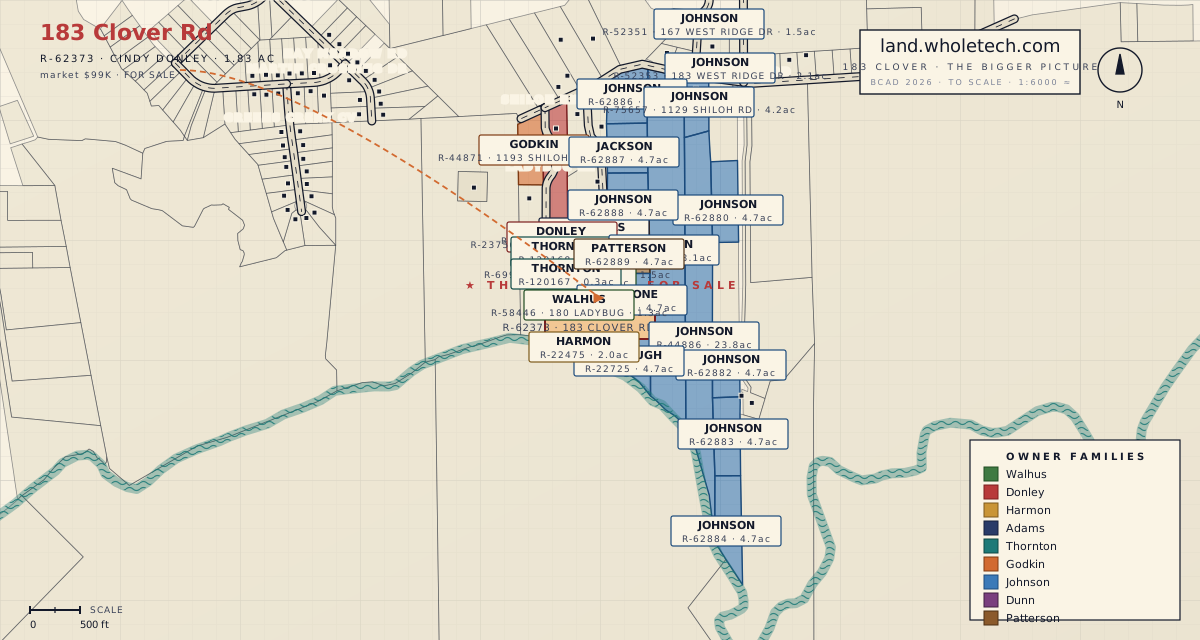
Today, 183 is a compound on a road. Add the strip behind it and 183 becomes the gateway parcel — the only one with road frontage, the only one a courier or a guest or a permit inspector can find. The strip becomes the back of the property: the creek, the wellhead, the fields. Two parcels, one identity.
The Johnson Strip parcels have no legal road access today. 183 Clover provides the only frontage that brings them out of landlock — which is exactly why they're acquirable at a discount.
183 unlocks the strip's value. The strip rewrites 183's identity from "rental house" to "creekside agricultural compound." Each parcel makes the other worth more than either is alone.
A live creek runs the length of the strip. Riparian frontage is the single rarest amenity in this corridor — every STR listing photo, every wedding-rental pitch, every "off the road"experience leans on water. You'd own that.
One of the parcels has a working artesian well — pressurized groundwater, no pump, free flow. That's irrigation water for an organic operation and a marketing asset on the rental side. You don't drill these; you inherit them.
Tillable acreage + artesian water + Bastrop County ag exemption pathway. A small organic operation (market garden, CSA, regenerative pilot) pays for itself, plays into the STR brand, and lowers property tax on the held land.
The strip can be assembled parcel by parcel, on rent or with owner-finance terms. Same playbook as 183: Matt Walker structures the deal. Start with the artesian-well parcel; expand as the rent roll funds the next step.
Lease the back parcels from the current Johnson family owners on a 3- or 5-year term with right of first refusal. Cost: a fraction of carrying owned land. Run the organic-farm pilot, prove the creekside STR pitch, then convert to ownership when the numbers are obvious.
Buy the strip outright — either parcel-by-parcel as cash allows or as a package with owner financing. You capture all the upside of the gateway re-rating (creekside + well + agricultural overlay), and 183 stops being defined by its road frontage and starts being defined by what's behind it.
183 Clover does not get bought without a guaranteed shared water agreement from the seller's well. Period. Out here in Cedar Creek there is no city water main to hook into — wells are the supply. The deal works because water is contractually assured; the deal does not work without it.
Paul has watched this exact issue go sideways on adjacent properties — when water is "understood" between neighbors instead of recorded, the next owner, the next dispute, or the next dry season vaporizes the arrangement. Five attorneys, multiple years, and tens of thousands of dollars to chase what one recorded paragraph could have prevented. 183 will not close on a handshake water deal.
A Shared Well & Water Use Agreement filed in Bastrop County records, attached to and surviving the deed. Not a side letter. Not an email. Recorded. Runs with the land so future owners on either side inherit the same terms.
Specified GPD floor (defined number, not "reasonable use") that 183 is contractually entitled to draw from the seller's well — sized to support the existing units plus the planned expansion (metal building, additional rentals).
The water right is structured as a perpetual easement appurtenant to 183 Clover — not a personal license to the buyer. A license dies when the buyer dies or sells. An easement is the land's right, not the person's.
Split of pump electricity, maintenance, and any future deepening or replacement spelled out in advance. A meter on each draw point so usage is measurable. Annual reconciliation. No "we'll figure it out."
What happens if the well runs low or fails: re-drill cost share, alternate-source obligation (hauled water), notice period, cure rights, and liquidated damages if the seller-side cuts the supply. Make non-performance expensive.
Buyer's owner's title policy at close must explicitly insure the recorded shared-well easement as a property right of 183. If the title company won't insure it, the agreement isn't structured right yet — re-draft before signing.
Once the shared-well agreement is recorded, the artesian well behind 183 on the Johnson Strip becomes a second water source — irrigation for the organic farm, a redundancy for the rentals, and a marketing asset on the STR side. Two independent water sources, one of them contractually guaranteed and title-insured. That's the right water posture for a compound at this scale.
Ten concrete moves to run in parallel between now and close. Each one has a goal, a done-when test, an owner, and a budget. None are speculative — every one of these is something a careful buyer in Cedar Creek would do anyway. Doing them in order, on the clock, is how this deal stays unlikely-to-blow-up.
List Del Valle. Park your metal building plans. Then call Matt at (512) 956-4714 and let him walk you through what an owner-financed 183 Clover purchase looks like with your Del Valle equity as down payment.
The seller is open. Matt knows the seller. The numbers above are the numbers — line-itemized, sortable, defensible — not a sales deck. Read the worksheet, then make the call.
Cash-flow positive in 30 days, or keep paying carry on raw dirt. Pick one.